Although Brazil’s 2026/27 crop is not expected to be directly impacted, the climate phenomenon may bring challenges for the next flowering cycle and for key producing regions in Central America and Asia, according to an analysis by Hedgepoint Global Markets.

El Niño is once again on the radar of global agricultural markets. Although it is a recurring climate phenomenon, its impacts vary depending on its intensity, duration, and the time of year it occurs, making the monitoring of weather conditions an essential tool for producers, exporters, industries, and other participants in commodity supply chains.
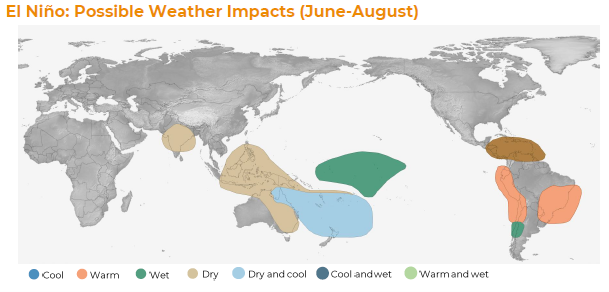
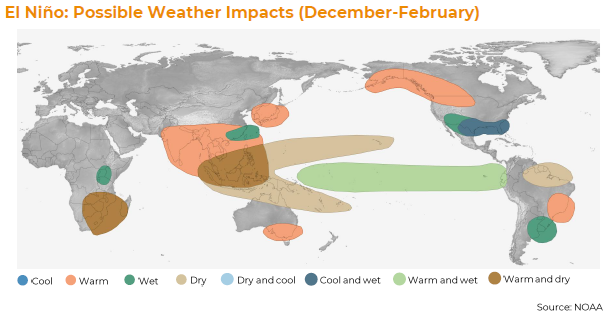
The most recent projections indicate the possibility of an active El Niño in the coming months, with the potential to extend into the Southern Hemisphere summer. Climate models currently point to a moderate-intensity event, but one that may gain strength over time, influencing temperature and precipitation patterns in key producing regions around the world.
Given this scenario, understanding how the phenomenon may affect different crops and markets is essential for decision-making. From grains such as soybeans, corn, and wheat to tropical commodities such as coffee, sugar, cocoa, and palm oil, the effects of El Niño can alter production outlooks, global availability, and, consequently, price dynamics. In this article, we analyze the key points of attention for each market and the regions that should remain in focus for market participants over the coming months.
The confirmation of a new El Niño episode for the second half of 2026 once again places weather among the key factors to watch in the global coffee market. While impacts vary depending on the producing region and the stage of the agricultural cycle when the phenomenon occurs, market participants are expected to closely monitor potential effects on global supply in the coming years.
According to Hedgepoint Global Markets, the effects of El Niño on coffee production depend on the intensity of the phenomenon, its duration, and the timing of its occurrence, as well as the specific weather conditions of each producing origin. As a result, impacts may differ across regions and crop years.
Brazil’s 2026/27 Crop Should Not Face Significant Production Impacts
In Brazil, the world’s leading coffee producer and exporter, current expectations indicate that the 2026/27 crop will not be directly affected by the climate phenomenon.
This outlook reduces immediate risks to Brazilian production. However, a wetter fall and winter could still delay the harvest and introduce some market volatility. Even so, weather conditions will continue to be monitored over the coming months, especially given projections of a strengthening El Niño during the second half of 2026.
Focus Shifts to the 2027/28 Crop
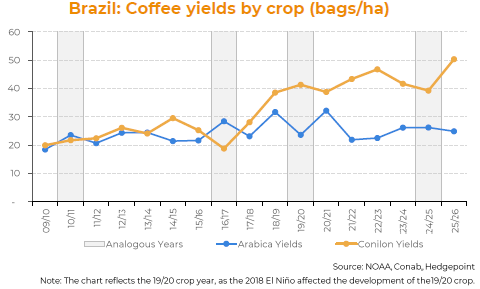
Despite expectations of limited impacts on the current crop, Hedgepoint notes that challenges may arise during the flowering stage of the 2027/28 crop.
Proper flowering development is one of the most critical factors in determining the productive potential of Brazil’s coffee fields. Therefore, changes in temperature and precipitation patterns during this period may influence outlooks for subsequent crop cycles.
Central America and Asia Emerge as More Vulnerable Regions
Outside Brazil, risks associated with El Niño tend to be more significant. According to Hedgepoint’s analysis, key producing regions in Central America and Asia may face negative effects on both the 2026/27 and 2027/28 crops.
These potential impacts stem from changes in weather patterns typically associated with the phenomenon, which can affect critical stages of crop development.
As a result, the market will continue to closely monitor climate developments in these regions, particularly in a scenario where global coffee supply remains highly dependent on weather conditions in major producing countries.
Market Monitors Medium- and Long-Term Risks
With the growing likelihood of a strong El Niño event between late 2026 and early 2027, market participants are expected to intensify monitoring of weather conditions across the world’s key coffee-producing regions.
While immediate impacts on Brazilian production appear limited, the possibility of effects on future crop cycles keeps weather as one of the main variables shaping market expectations.
“The impact of El Niño on coffee varies depending on the region and the time of year in which the phenomenon is active. In Brazil, production for the 2026/27 crop is not expected to be impacted, but challenges may arise for the harvest progress, and attention should be paid to the flowering stage of the 2027/28 crop. In other origins, especially in Central America and Southeast Asia, there may be negative effects on both the 2026/27 and 2027/28 crops,” highlights Laleska Moda, Market Intelligence Analyst at Hedgepoint.
Want to understand how El Niño could impact major global agricultural markets in the coming months?
Download the El Niño white paper from Hedgepoint Global Markets and gain access to a comprehensive analysis of commodities such as soybeans, corn, wheat, palm oil, cocoa, sugar, and coffee.
The study brings together climate assessments, production outlooks, and the key factors that may influence market prices and volatility, helping companies prepare for a scenario of greater uncertainty.
Rua Funchal, 418, 18º andar - Vila Olímpia São Paulo, SP, Brasil
Contato
(00) 99999-8888 example@mail.com