
Tariffs, the trade truce and the resumption of Chinese demand are once again influencing soybean prices in Chicago and global agricultural trade flows.
The "trade war 2.0", started in April by Donald Trump's US administration, has had a major impact on the markets throughout 2025, with significant changes in trade flows around the world. The application of tariffs on products from numerous countries has expanded the US targets compared to the previous trade war, which only targeted China. But just as in the previous one, the Asian country has once again become the main focus of US tariffs.
This led China to apply reciprocal tariffs on US products, including soybeans, the largest US agricultural product imported by the Asian country. This made it impossible for Chinese importers to buy US soybeans, which led to a significant drop in US exports, resulting in speculation and pressure on prices in Chicago.
This scenario continued until the end of October, when the US and Chinese presidents met in South Korea, sealing a "trade truce" that reduced tariffs on both sides. According to the US government, the truce (or supposed agreement) involved China committing to buying 12 million tons of soybeans from the US by the end of February, plus at least 25 million tons annually in 2026, 2027 and 2028.
Since then, Chinese purchases of US soybeans have resumed, with new sales of US soybeans to China being announced by the USDA after several weeks of absence.
As a result, the market began to react again in Chicago, with prices finding support in the return of Chinese demand. In any case, speculation has been rife again in recent weeks, with the market raising doubts about the true potential for Chinese purchases to reach their targets. Here's an update on US sales to the Asian country.
According to the USDA's weekly "Export Sales" report, as of November 27 China had purchased 3.015 million tons of soybeans for delivery in the 2025/26 season (which covers the period between September/25 and August/26). For comparison, in the same period last year, accumulated sales to China amounted to 16.483 million tons.
USA - Soybeans - Export sales
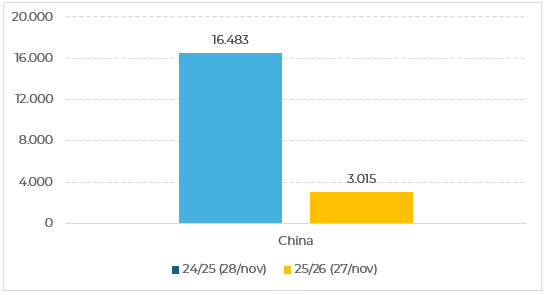
Source: USDA
Regarding sales to so-called "unknown destinations", which most of the time become China when they are shipped to US ports, by November 27 sales of 2.689 million tons had been recorded. For comparison, in the same period last year the accumulated sales to unknown destinations amounted to 6.226 million tons.
USA - Soybeans - Export sales
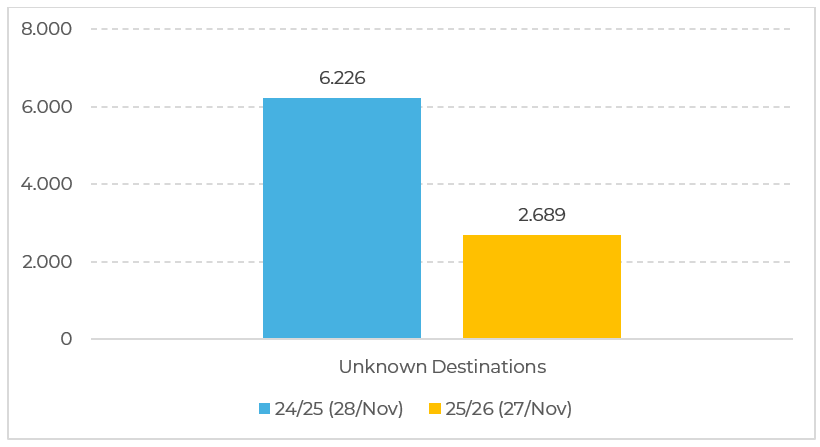
Source : USDA
Adding the volumes to China and unknown destinations up to November 27, we arrive at a total of 5.704 million tons for 2025/26. In the same period last year, the volume reached 22.708 million tons.
USA - Soybeans - Export sales
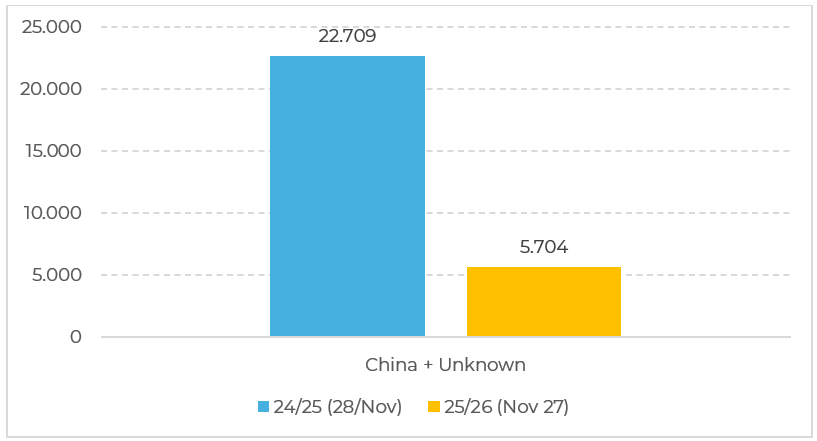
Source: USDA
However, to get a better idea of the accumulated volumes to date (December 19), we should also use the USDA data relating to daily sales (or "flash sales"), which comprise all sales of more than 100,000 tons on the same day that must be declared to the USDA by private US exporters.
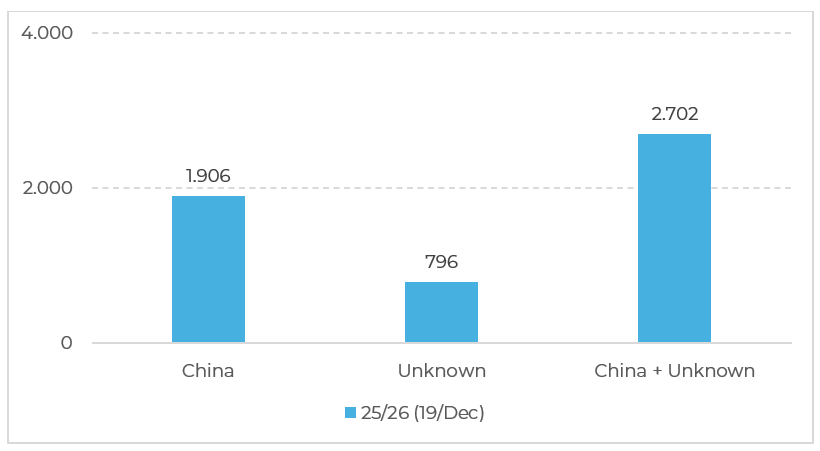
At this point, between November 28 and December 19, sales of 1.906 million tons to China and 796 thousand tons to unknown destinations were announced.
USA - Soybeans - Exports - Daily announcements (from 28 November to 19 December)
Source: USDA
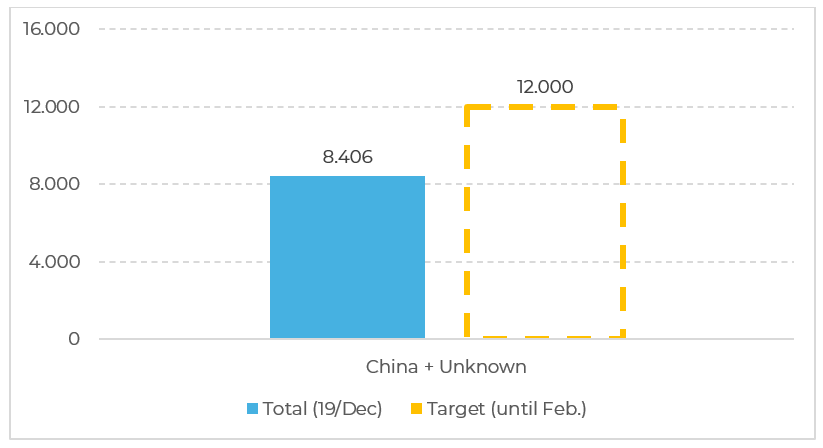
Adding up the volumes registered up to November 27 with the volumes announced between November 28 and December 19, we arrive at a total of 4.921 million tons for China and 3.485 million tons for unknown destinations, which results in a cumulative 8.406 million tons (China + unknown destinations).
USA - Soybeans - Export Sales + Daily Announcements
Source: USDA
This volume represents approximately 70% of the volume theoretically agreed between the countries for Chinese purchases until February (12 million tons). Given this, we believe it is possible and likely that China will reach the agreed volume. However, it is important to remember that there is no clarity regarding the terms of this supposed agreement, since only the US side has commented on it, with the Chinese side not confirming any commitment regarding volumes or deadlines so far.
In addition, the market is also speculating about the arrival of the next Brazilian harvest, which will bring greater supply and more competitive prices for the Chinese from February onwards, which could "disrupt" the pace of US sales to China.
The main question still remains: how much US soybeans will China actually buy over the course of 2026?
In this context, relying on Hedgepoint's market intelligence is key to anticipating trends and seizing opportunities in the biofuels market, ensuring a strategic position in the face of mandates and developments in the energy sector.
Contact us and find out how hedging tools can benefit your business.
This document has been prepared by Hedgepoint Global Markets LLC and its affiliates ("HPGM") solely for informational and instructional purposes and is not intended to establish obligations or commitments to third parties, nor is it intended to promote an offer, or the solicitation of an offer, to buy or sell any securities, futures, options, currencies and swaps or investment products. Hedgepoint Commodities LLC ("HPC"), a wholly owned entity of HPGM, is an Introducing Broker and a registered member of the National Futures Association. Trading futures, options, currencies and swaps involves significant risk of loss and may not be suitable for all investors. Past performance is not necessarily indicative of future results. Hedgepoint clients should rely on their own independent judgement and that of external advisors before entering into any transaction that is introduced by the company. HPGM and its associates expressly disclaim any liability for any use of the information contained herein that results directly or indirectly in damages of any kind. In the event of questions not resolved by our customer service team (client.services@hedgepointglobal.com), please contact our internal ombudsman channel (ombudsman@hedgepointglobal.com ) or 0800-878 8408/ouvidoria@hedgepointglobal.com (for customers in Brazil only).
Rua Funchal, 418, 18º andar - Vila Olímpia São Paulo, SP, Brasil
Contato
(00) 99999-8888 example@mail.com


.png)
.png)