The climate phenomenon may reduce water availability in key global producers, such as India, Thailand, and Central American countries
El Niño is once again on the radar of global agricultural markets. Although it is a recurring climate phenomenon, its impacts vary depending on its intensity, duration, and the time of year it occurs, making the monitoring of weather conditions an essential tool for producers, exporters, industries, and other participants in commodity supply chains.
The most recent projections indicate the possibility of an active El Niño in the coming months, with the potential to extend into the Southern Hemisphere summer. Climate models currently point to a moderate-intensity event, but one that may gain strength over time, influencing temperature and precipitation patterns in key producing regions around the world.
Given this scenario, understanding how the phenomenon may affect different crops and markets is essential for decision-making. From grains such as soybeans, corn, and wheat to tropical commodities such as coffee, sugar, cocoa, and palm oil, the effects of El Niño can alter production outlooks, global availability, and, consequently, price dynamics. In this article, we analyze the key points of attention for each market and the regions that should remain in focus for market participants over the coming months.
After a period marked by the recovery of global sugar supply, the market is beginning to turn its attention back to the potential impacts of a new El Niño episode on global production of the commodity.
In recent months, sugar prices have come under pressure from increased global availability, supported by the partial recovery of production in key Northern Hemisphere origins, such as India, Thailand, and Central America, as well as the strong performance of Brazil’s crop. As a result, the market began to operate with a more comfortable supply outlook and signs of a surplus in global trade flows.
Now, however, the evolution of weather conditions is returning to the spotlight. According to Hedgepoint Global Markets’ analysis, although Brazil should remain relatively resilient to the effects of the phenomenon, key producers in the Northern Hemisphere could face drier conditions in the coming months, raising risks to productivity and sugar availability in the international market in the 2026/27 crop year (Oct-Sep).
The 2026/27 Center-South Crop Maintains a Positive Outlook
In Brazil, the analysis focuses on the 2026/27 crop year in the Center-South, the country’s main sugarcane-producing region. In contrast with other major global producers, Brazil tends to show greater resilience under the projected weather scenario. In addition to the fact that sugarcane has already passed through the main development window for the current crop, the climate event tends to affect the southern region of the country more intensely, where sugarcane production is not significant.
Although it could eventually slow the pace of crushing if wetter weather extends across a broader area, the outlook remains positive for the Center-South sugar and ethanol sector. According to Hedgepoint, the crop should exceed 600 million tons for the fourth consecutive season, with production estimated at around 635 million tons. This volume reinforces the country’s position as the world’s leading sugar supplier and increases its importance to the balance of the international market.
This condition becomes even more relevant if production losses occur among major competitors in the Northern Hemisphere.
The Duration of the Phenomenon Will Be Decisive for Upcoming Cycles
Although the market’s attention is focused on the crop currently under development, sector participants are also monitoring the potential effects of the phenomenon on subsequent cycles.
If El Niño strengthens during the second half of 2026 and remains active through part of 2027, its impacts could extend beyond the current season, influencing market decisions and supply expectations for the next production cycles. Higher rainfall in the southern portion of the Center-South region could be positive for the development of the 2027/28 crop, although it is still too early to confirm any trend.
India and Thailand Account for Some of the Concerns
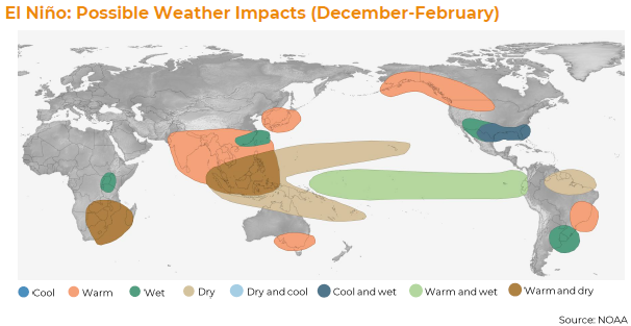
While Brazil tends to experience more limited impacts from the phenomenon, the market’s attention is shifting toward key producers in the Northern Hemisphere.
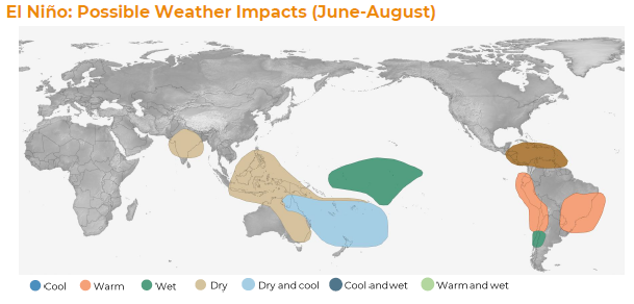
India and Thailand are among the regions that historically may be affected by drier conditions during El Niño events. Reduced rainfall and higher temperatures increase the risk of water stress for sugarcane fields, potentially compromising both productivity and the availability of raw material for sugar production as early as their 2026/27 crop year, which begins in October 2026.
Because both countries play an important role in the international trade of the commodity, potential production losses are usually quickly incorporated into market participants’ expectations.
Central America Also Comes Into Focus
In addition to Asia, Central America is among the regions being monitored as weather projections evolve.
The phenomenon may favor drier conditions in producing countries across the region, increasing risks to sugarcane development and to exportable volumes. Although impacts vary according to the intensity of the event and the local characteristics of each crop, the region is part of the group of origins that may face additional challenges if El Niño strengthens in the coming months.
Crop Calendars Help Explain the Risks
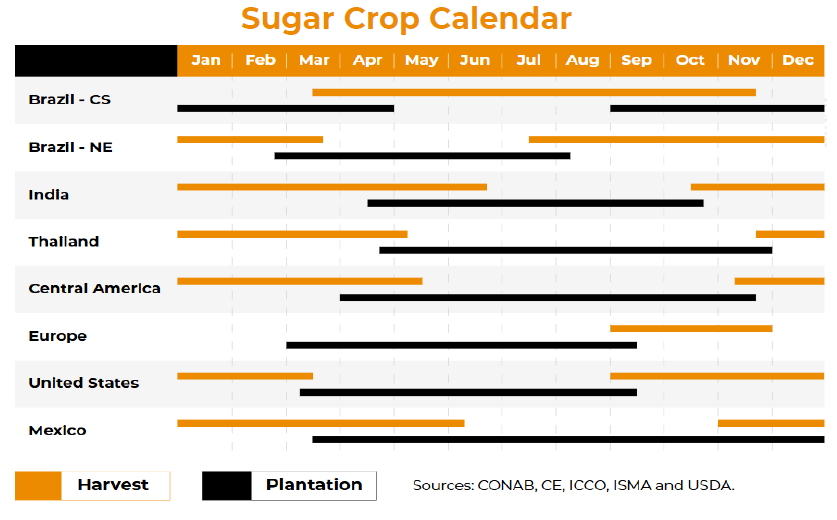
The potential effects of El Niño on the sugar market should be analyzed alongside the production calendars of the main exporting countries.
Because planting, development, and harvesting periods vary across different origins, climate impacts also tend to occur at different times. For this reason, the market is simultaneously monitoring the evolution of the 2026/27 crop in key global producers and the potential effects on subsequent cycles, depending on the duration of the climate phenomenon.
Dependence on Brazilian Supply May Increase
Although the current scenario is marked by more comfortable global supply, market participants are already beginning to assess the potential effects of the phenomenon on the next season.
Historically, El Niño episodes alter precipitation patterns in several producing regions, influencing sugarcane development and agricultural productivity levels. Therefore, the intensity and duration of the event will remain key factors shaping the sector’s expectations.
If the phenomenon intensifies during the second half of 2026 and remains active into 2027, Brazil’s participation could become even more important to the global balance of the market.
“The combination of relatively more favorable conditions in Brazil and potential production challenges in other origins reinforces the need for constant monitoring of weather conditions and their effects on global supply,” says Livea Coda, Market Intelligence Coordinator at Hedgepoint Global Markets.
Want to understand how El Niño could impact major global agricultural markets in the coming months?
Download the El Niño white paper from Hedgepoint Global Markets and gain access to a comprehensive analysis of commodities such as soybeans, corn, wheat, palm oil, cocoa, sugar, and coffee.
The study brings together climate assessments, production outlooks, and the key factors that may influence market prices and volatility, helping companies prepare for a scenario of greater uncertainty.
Rua Funchal, 418, 18º andar - Vila Olímpia São Paulo, SP, Brasil
Contato
(00) 99999-8888 example@mail.com