Follow the outlook for the global sugar market for 2025/26, given the uncertainty caused by the U.S.-Iran conflict.
-1.png)
The global sugar market entered the 2025/26 cycle (Oct-Sep) under a surplus dynamic, which, in theory, would set up a bearish scenario for the commodity's prices. However, the conflict between the United States and Iran has changed the scenario.
According to theInternational Sugar Organization (ISO) and commodity market reports, the 2025/26 cycle is likely to see a surplus in global supply, reflecting production recovery in key countries and the maintenance of high volumes in Brazil.
For agents in the sugar-energy sector chain, understanding some of the sector's variables, in the face of such volatility, is essential for strategic planning. Want to know more? Read on:
Let's go?
The conflict between the US and Iran will inevitably affect the sugar market. Geopolitical tension opens up a number of fronts that offer support to prices.
The first trigger is oil. As the price of a barrel of oil rises, so do the costs of sugar production and logistics, i.e. everything from the field to the port becomes more expensive. In Brazil, there is an extra effect: high energy prices tend to sustain ethanol at higher levels, which directly influences the mills' decision between producing more ethanol or more sugar.
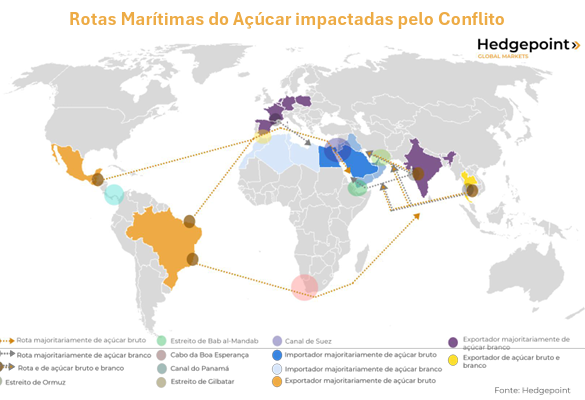
But the impacts go beyond fuels. Trade routes to the Middle East become longer, riskier and, consequently, more expensive. As a result, insurance and freight costs skyrocket, making it more difficult to transport Brazilian and Central American production to the region.
Finally, there is a less obvious but relevant effect: large refineries in the Middle East, such as Dubai's Al Khaleej, face difficulties in receiving raw sugar and disposing of white sugar, which creates additional pressure on the refined sugar contract on the international market, listed on the London Stock Exchange.
Apart from the wider effects on commodities, the conflict between the United States and Iran has affected sugar routes to East Africa and the Middle East, as can be seen in the graph:
 .
.
Follow in detail:
As far as fundamentals are concerned, a few developments have emerged which, when combined, have had a subtle impact on the sugar market.
The first concerns sugar availability in India, followed by an offsetting adjustment in Thailand. Our initial estimate for India's 25/26 harvest predicted sugar production of 31.1 Mt, detour to ethanol of 3.7 Mt and exports of 1.5 Mt.
However, lower yields, partly linked to flowering problems in the cane fields and difficulties in carrying out crop management due to the weather, led to a downward revision in production to 28.5 Mt, with exports reduced to just over 700 kt. As a result, the global trade surplus decreased from 1.8 Mt to around 1.1 Mt.
In addition, expectations that India could increase its share of global trade in 26/27 are now in jeopardy, not only due to the weaker recovery in 25/26, but also amid the possibilities of El Niño occurring.
To maintain a conservative stance, we have now assumed stable production levels and potentially no exports from India in the following season. These revisions regarding India would bring our trade flows into balance between the fourth quarter of 2025 and the first quarter of 2027.
In contrast, Thailand's prospects have improved. Despite concerns about white leaf disease, yields are exceeding expectations. Production has been raised from an initial estimate of 10.5 Mt to around 11.5 Mt, adding approximately 1 Mt to global trade flows, bringing them back to a situation of oversupply.
Higher oil prices also impact the sugar market, increasing production and logistics costs throughout the supply chain, from fertilizers and field operations to milling, refining and export freight.
The intensification of the conflict between the United States and Iran has substantially raised oil prices since the beginning of 2026, which directly impacts sugar production and logistics costs.
In Brazil, higher energy prices could support ethanol parity, possibly raising the effective floor for sugar prices. The current scenario reinforces the sugar market's dependence on factors outside its fundamentals, such as Petrobras' passing on of costs, which could influence the price floor for the harvest.
The possible reduction in availability in India tends to be at least partially offset by better prospects in Thailand and a more flexible production mix in Brazil. In the Brazilian Center-South, recent data from UNICA reinforces the expectation of a 2025/26 harvest (Apr - Mar) of around 610 Mt of cane, resulting in approximately 40.5 Mt of sugar.
Climatic conditions continue to be favorable for sugarcane development, which adds upside risks for the 2026/27 harvest, currently estimated at 630 Mt. If this scenario is confirmed, the fundamentals remain predominantly bearish, since supply shocks from other sources could be absorbed by Brazil.
Brazil is consolidating its position as the largest exporter and main price maker in the global sugar market. According to USDA and ISO data, the country accounts for approximately 40% of global sugar exports.
For the 2025/26 cycle, several specialist consultancies point to the possibility of a surplus in the global trade flow, with estimates of a surplus of between 1.5 and 1.7 million tons in the annual balance (October-September).
A determining factor in Brazil's competitiveness is exchange rate movements. The devaluation of the real against the dollar tends to favor the profitability of Brazilian exports, since sugar traded on the international markets is quoted in dollars, with reference to the ICE Futures US exchange in New York.
In this context, the arbitrage between the domestic market and the international market becomes a central element in defining the destination of production.
In addition, Brazil has flexibility in the use of sugarcane to produce sugar or ethanol, reflected in the so-called "sugar mix" index. The rise in the energy complex has provided support for sugar as the market has priced in the possibility of Petrobras passing on costs, which would lead to a rise in fuel prices and, therefore, in the main competitor for raw materials: ethanol. This opens up the possibility of sugar being worth more even in the context of a surplus and less sugar expected for 2026/27.
As we highlighted earlier, there are two main channels through which sugar prices could find support in the context of the war between the US and Iran. First, higher energy and fertilizer prices, which, once maintained, could raise production costs throughout the supply chain.
Secondly, firmer ethanol prices on the Brazilian domestic market, driven by a possible passing on of import costs by Petrobras, which could raise the ethanol parity and, in turn, provide a higher floor for sugar prices.
It is worth noting, however, that none of these factors imply a change in the intrinsic fundamentals of the sugar market. Thus, should the conflict calm down and part of the recent gains in the energy complex be reversed, the associated price support would probably dissipate accordingly.
The recent support for sugar prices, therefore, does not stem from changes in fundamentals, but rather from the adjustment of market agents' expectations, also relying on speculative movements such as the hedging of short positions by funds, in addition to the strengthening of the energy complex.
Recently, the market tested and found a temporary equilibrium range between 15.4 and 15.9 c/lb, with resistance close to the ceiling of this range. This level is considered fragile, as it is sustained by external factors and high macroeconomic and geopolitical volatility, rather than by a structural turnaround in supply and demand.
In this scenario of climatic and economic uncertainty, the use of market intelligence tools is indispensable.
Hedgepoint HUB has emerged as an essential platform for monitoring these variables in real time. The platform offers in-depth analysis of trade flows, stocks and price trends to help mitigate risks and make strategic decisions.
Sign up to Hedgepoint HUB now and keep a close eye on risk variables and market changes!
Rua Funchal, 418, 18º andar - Vila Olímpia São Paulo, SP, Brasil
Contato
(00) 99999-8888 example@mail.com